Yes, an event stage can sometimes be installed on grass, but the surface, slope, drainage, access and structure all need checking before the build is agreed.

September 15, 2026
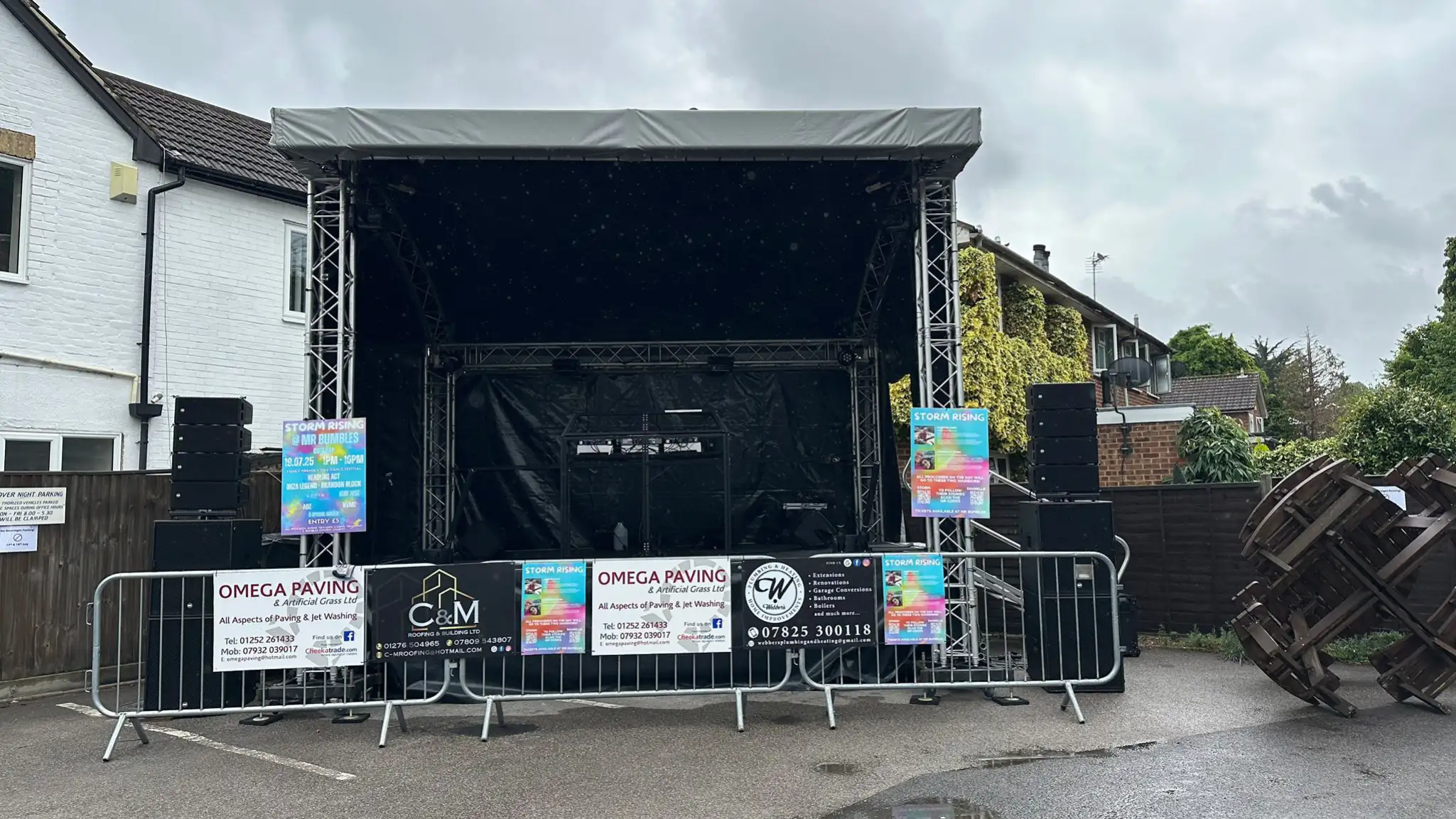
Yes, an event stage can often be installed on grass. That does not mean every patch of grass is suitable.
The supplier needs to understand the surface, slope, drainage, vehicle route, available footprint and the structure being proposed. A dry, firm site with straightforward access is a different job from soft ground at the bottom of a slope after a week of rain.
The sensible answer is not “grass is fine” or “grass is unsafe”. The answer is that the site must be assessed against the stage, the expected conditions and the way equipment will reach it.
This guide explains what organisers should check before booking a stage for a field, park, estate, school ground, garden or other outdoor site.
A suitable position needs enough clear space for the complete structure, a surface that can support the proposed setup and a practical route for delivery and installation.
The HSE guidance on venue and site design tells organisers to consider ground conditions, topography, vehicle and pedestrian movement, and the position of temporary structures. Those checks should happen before the site layout is treated as final.
Do not assess the field as one large area. Mark the precise location and orientation of the proposed stage. Check:
A large field can still have only one practical stage position once access, audience flow and ground condition are considered.
The answer depends on the stage system and the proposed build. Minor variation may be manageable with a correctly specified modular system. A pronounced slope, sudden level change or unstable surface needs a proper assessment and may require a different position or engineered solution.
Do not try to solve a slope by placing loose timber, paving slabs or improvised packing under a hired stage. The supplier should specify how the structure will be supported and levelled.
A field being large enough does not make it buildable. The exact stage position, surface and delivery route all have to work.
“Grass” describes the surface, not what is underneath it.
Useful questions include:
Ground condition can change between the first enquiry and build day. Agree who will check it again if the forecast changes or the site becomes damaged by other contractors.
Hardstanding may make vehicle movement easier, but it still needs checking. The surface may slope, cover underground services, have restricted anchoring options or sit above a structure with a load limit.
Gravel and loose stone can create levelling, access and trip issues. Block paving may have landowner restrictions or damage risks. Indoor floors can also have loading limits and protected finishes.
Tell the supplier what the surface is made from and who can confirm any site restrictions. Do not assume hard ground removes the need for planning.
Covered stages and roof structures may require anchoring, ballast or another event-specific support method. The correct solution depends on the structure, site and conditions.
Ask the supplier what information they need and what must be kept clear around the structure. Never publish or rely on a generic ballast figure copied from another stage. The required arrangement has to come from the relevant design and competent supplier.
The HSE also provides information on temporary demountable structures for organisers who need a starting point.
The stage position may be firm and level while the route to it is unusable.
Send details of:
If a vehicle cannot reach the build area, the equipment may need to be moved farther by hand or with suitable site equipment. That changes the crew, schedule and price. Tell the supplier early instead of hoping the driver can work it out on arrival.
Temporary trackway or ground protection may be needed to protect the venue, support access or reduce damage on soft routes. Whether it is required depends on the vehicle, surface, weather and landowner rules.
Ask who is supplying it, which route it covers and when it will be installed. Ground protection that arrives after the stage vehicle is useless.
Look above and below the proposed build:
The organiser or venue should provide available service information. The stage supplier cannot infer what is buried from a photograph of the grass.
Take wide and close photographs. Include:
Photographs should support measurements, not replace them. If a gate width or ceiling height matters, measure it.
A site visit may be sensible when:
Not every small modular platform needs a separate visit. The supplier should decide what information is enough for the proposed build rather than using one rule for every job.
Agree who will review the ground and access route if conditions change. The build may need additional protection, a different vehicle plan, a revised position or a decision that the original setup cannot proceed safely.
A covered stage protects the performance area from some weather. It does not make waterlogged ground suitable or remove wind and operating limits.

Send this information with the event date, stage use, audience and performer requirements. Use the stage hire quote checklist for the rest of the brief.
Beatz Hire supplies an 8m x 6m covered Milos MR1 arc roof stage and modular Prolyte LiteDeck staging, with delivery, installation and collection across the South East.
Send the venue, exact stage position, ground photographs, measurements, vehicle route, audience and production brief. You can also view local stage hire information for Southampton, Winchester, Reading and Oxford.
Have a question or ready to get started? Let us know what you need, and our team will guide you every step of the way to make your event exceptional.
Reach out to us directly via email or phone—we’re here to assist you with any inquiries or bookings.
Stay connected and see our latest events, updates, and behind-the-scenes moments.


