Planning an outdoor festival and not sure what sound system you actually need? This guide breaks down real pricing, equipment setups, and how to get clear audio across your entire crowd, so your event runs smoothly from start to finish.
May 6, 2026
Outdoor sound looks simple until you actually run it.
You set up a couple of speakers, plug in a microphone, and expect it to work like an indoor event. Then the issues start straight away. People at the back can’t hear announcements, music sounds thin, and the whole event starts to feel disorganised.
The reason is simple. Sound behaves differently outdoors. There are no walls to contain it, wind can push high frequencies away, and volume drops the further it travels. Every time the distance doubles, the sound level drops, which is why a setup that works for 100 people completely fails at 500.
If your sound isn’t right, everything else suffers. Timing gets missed, instructions aren’t clear, and the event loses control quickly.
Most websites avoid giving real numbers. Here’s what it actually looks like.
If you need a sound technician on-site:
For larger festivals or full production setups, pricing depends on how far you need sound to travel, how many zones you’re covering, and whether you need staging, lighting, or power included.
Most people think in terms of speakers. The reality is coverage.
For smaller events, a simple two-speaker setup works. Clear audio for speeches, background music, and low-key performances.
Once you move into 150 to 300 people, you need subwoofers. Without them, the sound feels flat and doesn’t carry properly.
At 300 to 500 people, you need more output and wider spread. That usually means adding more low-end and positioning speakers properly across the space.
At 500 and above, you’re into proper festival sound. This is where line array systems come in. Instead of blasting sound from one point, they project audio evenly across the crowd so people at the back hear the same as people at the front.
The difference isn’t volume. It’s consistency.
Adding more speakers doesn’t fix bad sound.
If anything, it can make it worse.
When speakers aren’t positioned correctly, sound waves overlap and interfere with each other. That creates dead zones, echo, and areas where the audio drops out completely.
At a 10km and half marathon event in the Cirencester area with around 1,500 people, the finish line crowd stretched further than expected.
Instead of turning everything up, the system was adjusted to spread sound across the full finish area. Speakers were positioned and tuned so they worked together instead of clashing.
The result was clear announcements across the entire crowd, even at the back, without distortion or feedback.
That’s the difference between a basic setup and a planned one.
Most blogs stay vague here. This is what actually gets used.
For smaller events:
For medium events:
For larger events and festivals:
We own our core equipment and can scale up through trusted suppliers when events need more than our in-house stock. That means setups can grow with the event instead of being limited.
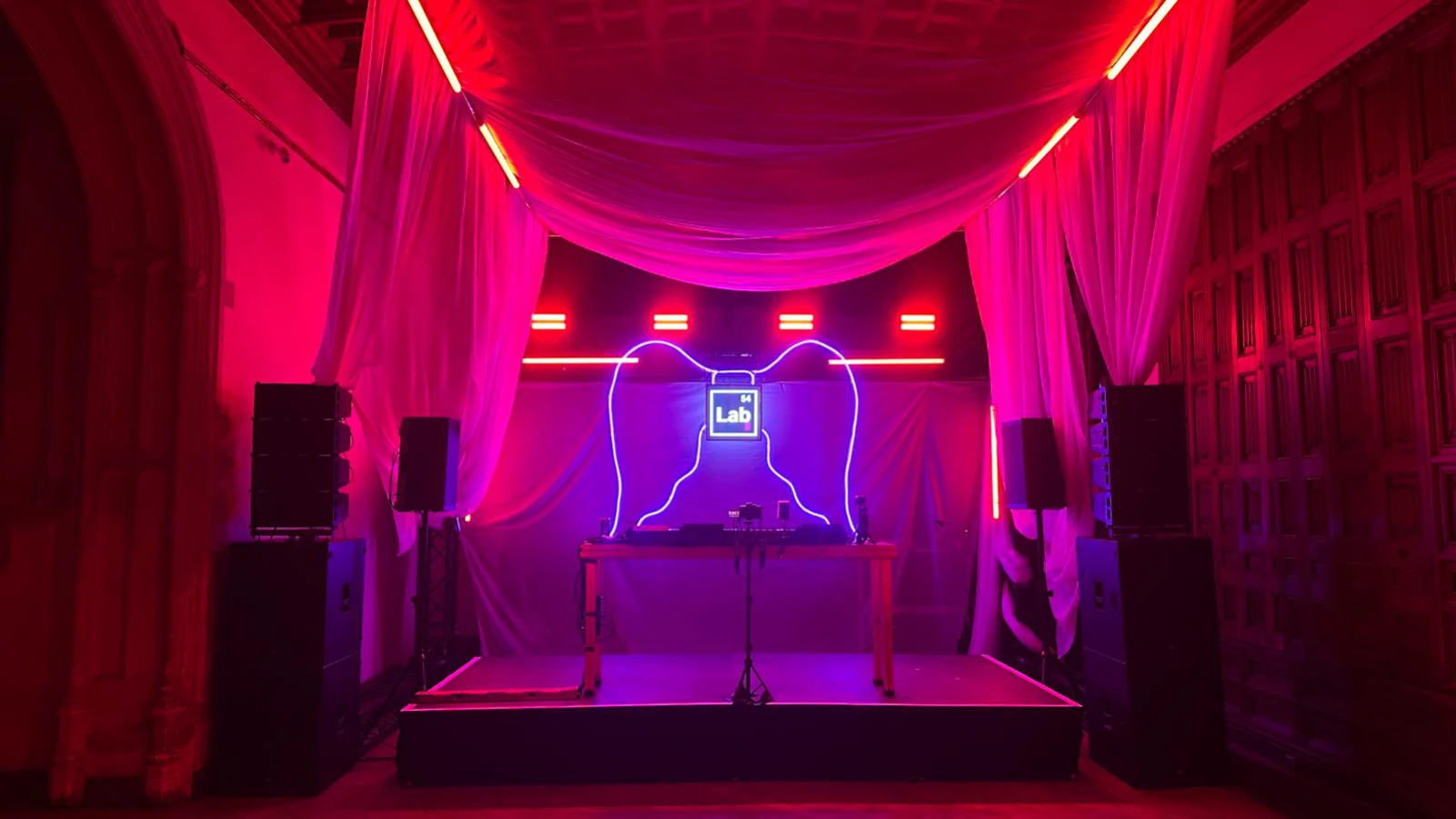
For a Lab54 tour stop in Liverpool with around 1,000 attendees, the setup included full sound and lighting.
This wasn’t treated as basic speaker hire. It was planned as a full production setup with proper coverage across the entire audience area.
The system was designed so sound stayed consistent from front to back, with enough low-end to carry the energy of the event and enough clarity for announcements and transitions.
Build time, positioning, and system tuning all played a part in making sure the event didn’t just sound loud, but sounded right.
That’s the difference at this level.
This is where most blogs stop. This is also where events go wrong.
Power
Outdoor events don’t always have reliable power. If your system draws more than the available supply, you get dropouts or complete failure. Larger setups often need generators and proper distribution planning.
Wind
Wind affects high frequencies first. That means vocals and clarity disappear before volume does. You can still hear something, but it sounds unclear. System positioning and speaker type matter here.
Audio Zones
Not every part of your event needs the same sound level. A stage area, food zone, and entrance all need different coverage. Without zoning, you either blast everything too loud or leave areas with no sound at all.
These are the details that separate a controlled event from one that feels messy.
Most organisers start by looking for sound hire.
But most outdoor events need more than just speakers.
They need:
Running everything through one provider keeps the setup coordinated and avoids different teams working against each other on the day.
If you’re planning an outdoor event, the fastest way to get this right is simple.
Provide:
From there, the setup can be matched properly to your event instead of guessing.
Outdoor festival sound is not about volume. It’s about coverage, clarity, and control.
A setup that works for 100 people will fail at 500 if it’s not designed properly. A setup that works for 500 will struggle at 1,000 without proper planning.
The difference between a smooth event and a chaotic one usually comes down to how well the sound is handled.
If people can hear clearly, everything feels organised. If they can’t, nothing else saves it.
Tell us your event type, expected crowd size, and location. We aim to respond the same day and provide a full quote within 24 to 48 hours depending on the details.
Get in touch with Beatz Hire and we’ll make sure your event sounds right from start to finish."
How much does it cost to hire a sound system for an outdoor festival?
Outdoor sound system hire typically starts from £450 and can exceed £2,000+ depending on crowd size and setup.
What sound system do I need for 500 people outdoors?
For 500 people, you’ll need a system with subwoofers and proper coverage, often including multiple speakers or a small line array setup.
Do I need a sound engineer for my event?
For small events, it’s optional. For medium to large events, a sound engineer helps maintain consistent audio and manage issues in real time.
Why does sound drop off outdoors?
Sound spreads freely outdoors without walls to reflect it, meaning volume drops over distance and can be affected by wind.
Can you supply full event production as well as sound?
Yes, sound can be combined with staging, lighting, and power for a complete event setup.

Have a question or ready to get started? Let us know what you need, and our team will guide you every step of the way to make your event exceptional.
Reach out to us directly via email or phone—we’re here to assist you with any inquiries or bookings.
Stay connected and see our latest events, updates, and behind-the-scenes moments.


