What a professional stage supplier should handle, including specification, delivery, installation, access, handover and coordination with sound and lighting.
September 15, 2026
A stage is the focal point of any live event. Everything else, the sound, the lighting, the entertainment, is built around it. Get the stage right and the event has structure, energy, and a professional feel from the moment guests arrive. Get it wrong and performers have no room, sightlines are poor, and the production looks unfinished regardless of how much was spent on everything else.
This guide explains why professional stage hire matters, what to consider when choosing a stage, and what realistic costs look like for events across the South East.
Written by Jack Bridges, Founder of Beatz Hire and Event Production Specialist, supporting events across London and the South East.
At Beatz Hire, we supply stage hire for festivals, corporate events, outdoor markets, Christmas events, awards nights, and private functions across London, Surrey, Berkshire, Hampshire, Oxfordshire, and Buckinghamshire. We provide modular staging, arc roof covered stages, DJ stages, and full production packages. This guide is based on real delivery experience across a wide range of outdoor and indoor events.
Hiring a stage is not just about having a raised platform. It is about giving your event a professional foundation that makes everything else work better.
A properly built stage gives performers a safe, level working space. It gives your sound and lighting team the rigging points and clearance they need to install equipment correctly. It gives the audience clear sightlines to the performance. And it gives the event a visual anchor that makes the whole site feel organised and intentional.
Without a stage, events often feel disjointed. Entertainment blends into the crowd. Sound systems sit on the ground on stands. Lighting has nowhere to hang. The result is an event that looks like it was assembled in a hurry, regardless of how much effort went into planning it.
Every successful event needs a focal point. A stage provides exactly that.
Whether it is a festival, a corporate summer party, a Christmas market, or a sports day, having a defined stage area tells attendees where to go, where the entertainment is happening, and where to focus their attention. It naturally draws people in and concentrates energy in one place.
This matters practically as well. A clear focal point makes crowd management easier, gives photographers and videographers a defined shooting position, and helps the event flow from one element to the next without confusion.
Without a stage, entertainment gets lost. A DJ playing at ground level in a large outdoor space feels like background music. The same DJ on a raised stage with a backdrop becomes the centrepiece of the event.
Elevation is the simplest way to ensure more people can see what is happening.
At ground level, anyone beyond the first few rows of a crowd struggles to see performers. A raised stage solves this immediately. Even a modest elevation of 60 to 90 centimetres dramatically improves visibility for a large proportion of the audience.
For larger events, sightlines affect not just visibility but also how engaged the audience feels. An audience that can see clearly is more attentive, more energetic, and more connected to the performance. An audience straining to see over heads in front of them becomes distracted and disengaged.
This is the reason most event organisers underestimate.
A stage is not just a platform for performers. It is the structural foundation for your entire production. Without a properly built stage, sound and lighting systems cannot be installed correctly.
PA speakers need elevation and correct positioning to cover the audience evenly. A professional stage gives them the height and rigging points to achieve this. Without it, speakers sit on the ground or on stands that are not stable enough for larger systems, which limits both coverage and quality.
Lighting rigs need something to hang from. A covered arc roof stage provides the truss structure that lighting fixtures attach to. Without it, lighting either does not happen or ends up on ground stands that limit what can be achieved aesthetically and practically.
At Beatz Hire, we supply stage hire and production together because the two elements are directly connected. A stage that is the wrong size or the wrong type makes the sound and lighting job significantly harder. Planning them together from the start avoids this.
Outdoor events in particular need a covered stage. The UK weather is unpredictable and an uncovered stage puts performers, equipment, and cabling at serious risk.
A covered arc roof stage provides a weatherproof structure that allows events to continue safely in rain and wind. It also protects expensive audio and lighting equipment from moisture, which is one of the most common causes of technical failures at outdoor events.
Beyond weather protection, a raised stage also creates a physical separation between performers and the crowd. This protects performers from being rushed at large events, and protects the audience from the technical hazards associated with live performance, including cabling, speakers, and electrical equipment.
For events with large crowds or high-energy performances, this separation is not just practical, it is a health and safety requirement.
The stage is one of the first things guests see when they arrive at an event. It sets expectations for everything that follows.
A well-built stage with a clean backdrop, proper lighting, and professional branding signals that the event is organised, properly resourced, and worth attending. It communicates credibility before a single performer steps on to it.
Conversely, an improvised setup with no dedicated stage, ground-level speakers, and makeshift lighting tells guests the event was underprepared. That impression is difficult to reverse regardless of how well the rest of the event runs.
For corporate events, branded stage sets create an additional opportunity to reinforce company identity. Branded fascias, printed backdrops, and gobo lighting can all be integrated into a professional stage setup to create a coherent visual identity throughout the event.
Not all stages are the same. The right choice depends on event type, crowd size, venue, and whether the event is indoors or outdoors.
Suited to corporate events, awards nights, conferences, and private functions held indoors. Modular staging systems can be configured in multiple shapes and sizes to suit the venue and event format. Heights typically range from 40 to 120 centimetres depending on audience size and room configuration.
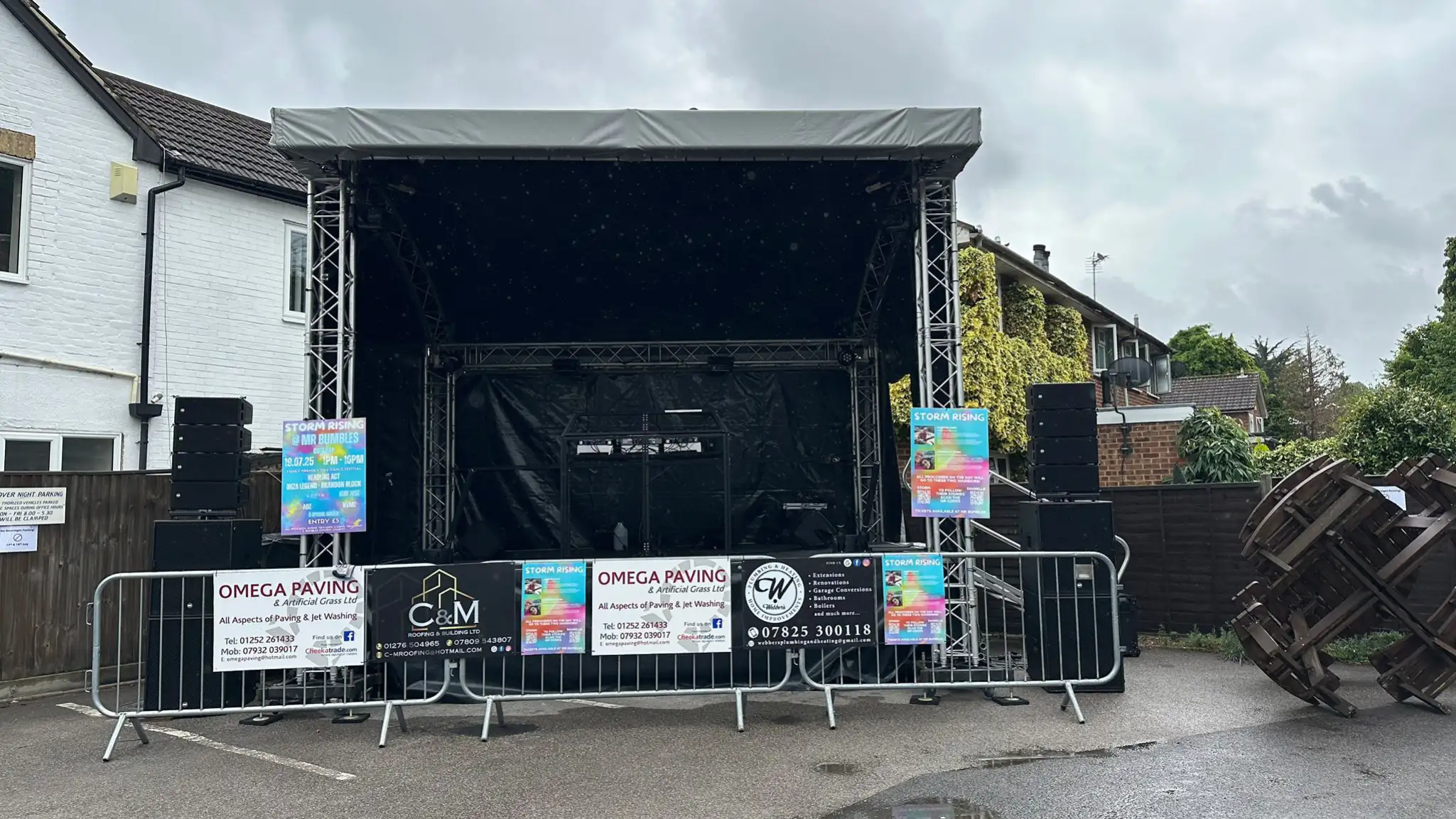
Suited to festivals, outdoor concerts, community events, Christmas markets, and corporate outdoor events. The arc roof structure provides weather protection and rigging points for lighting, PA speakers, and branding. Our most popular outdoor stage is the 8m x 6m covered arc roof stage, which suits events from around 200 to 1,000 attendees.
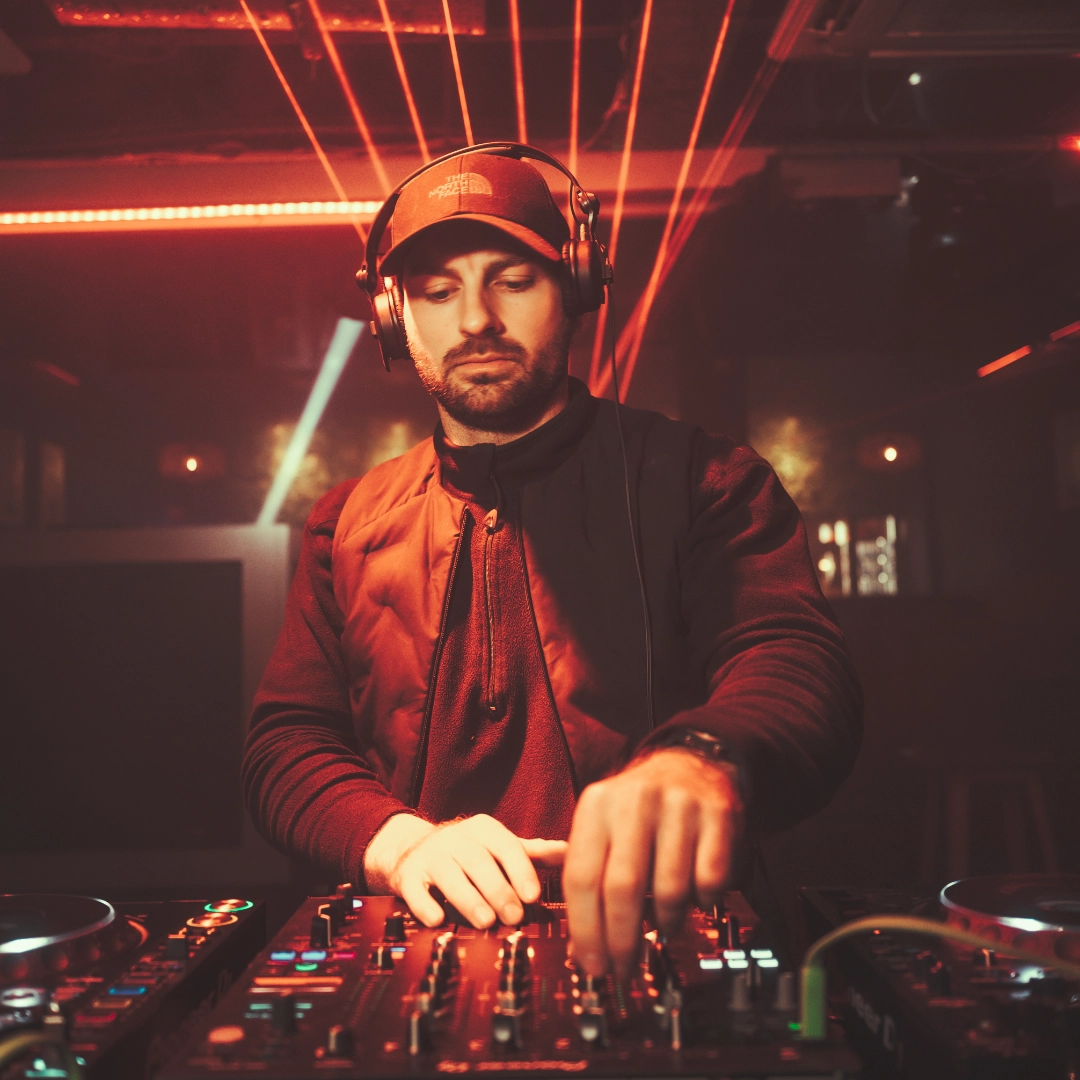
Suited to parties, club nights, corporate Christmas events, and outdoor DJ events. A DJ stage positions the DJ at the right height for the audience and provides a clean, professional working position for the equipment.
Suited to larger outdoor festivals and public events requiring a full production stage with rigging, truss, roof structure, and integrated sound and lighting.
Pricing depends on stage size, roof type, indoor vs outdoor, and whether production equipment is included.
From £300 to £800
Suited to events up to around 150 guests. Usually includes a modular platform, stairs, and skirting.
From £1,500 to £4,564 plus VAT
Suited to events from 200 to around 1,000 guests. Includes arc roof structure, rigging points, stairs, and handrails.
From £4,500 to £7,500 plus
Suited to larger festivals and public events. Includes heavy-duty roof system, structural rigging, and technical support.
From £3,500 to £20,000 plus
Includes stage, PA system, lighting rig, wireless microphones, and technical crew. Booking production together with staging removes coordination problems and usually reduces overall cost.
Booking early, particularly for summer events, protects availability and pricing.
Do you own the staging equipment? Owned kit means better availability and fewer delays caused by third-party sourcing.
Is delivery, build, and takedown included? Some suppliers quote structure only. Always confirm before comparing prices.
Can you supply sound and lighting alongside the stage? Using one supplier for the full production reduces coordination problems significantly.
What are the ground and access requirements? Soft ground, slopes, or restricted vehicle access affect what stage can be safely installed and how long the build takes.
What weather protection does the stage provide? For any outdoor event in the UK, a covered stage is strongly recommended.
How long does the build take? A medium outdoor stage typically takes three to four hours to build. Factor this into your venue access window.
Choosing a stage that is too small. Performers need room to move. A band with four members and full backline needs significantly more stage depth than a single DJ. Under-sizing the stage creates a cramped, unprofessional setup.
Not checking ground conditions. Soft or uneven ground affects what stage can be safely installed. Always discuss ground conditions with your supplier before confirming.
Leaving stage hire until last. Stage booking affects everything else. The stage size determines speaker positioning, lighting design, and load-in logistics. Book it alongside the venue, not after everything else is confirmed.
Assuming an uncovered stage is fine for outdoor events. UK weather is unpredictable. An uncovered stage puts performers, equipment, and your event schedule at risk.
Booking stage from one company and production from another. When the staging and production crew are different companies, coordination problems are common. Different load-in times, incompatible rigging expectations, and nobody taking overall responsibility are all frequent issues.
A stage creates a focal point, improves audience sightlines, provides structural support for sound and lighting, protects performers, and gives the event a professional appearance. Without one, even well-funded events can look improvised.
Small indoor stages start from around £300. Medium outdoor covered stages typically cost £1,500 to £4,564 plus VAT. Large festival stages can reach £7,500 or more depending on size and specification.
Yes, for most UK outdoor events. An uncovered stage puts performers and equipment at risk from rain and wind. A covered arc roof stage also provides rigging points for lighting and PA systems that an uncovered platform cannot offer.
For summer events, three to six months is sensible. December events should be booked similarly early. Last-minute bookings are sometimes possible but availability narrows quickly during peak season.
Yes. Beatz Hire provides stage hire, PA systems, lighting, wireless microphones, and technical crew as a single booking. This removes the coordination problems that arise when different suppliers work the same event.
As a rough guide: up to 200 attendees, a 4m x 4m or 6m x 4m stage. For 200 to 1,000 attendees, an 8m x 6m covered stage. For larger events, 10m x 8m or above. The type of performance also affects the size required.
No. Beatz Hire covers London and the wider South East including Surrey, Berkshire, Hampshire, Oxfordshire, and Buckinghamshire.
Whether you need a small modular indoor stage or a large covered outdoor production stage, Beatz Hire can help.
Tell us your event type, expected crowd size, venue, and date. We will recommend the right stage, confirm availability, and quote quickly.
Call Beatz Hire on 01252 929414 or fill in the form below.

A supplier should ask about the venue, surface, access, audience, performers, equipment and running order before recommending a build. Compare our stage size guide and local stage options for London, Reading, Oxford and Southampton.
For wider venue and site checks, the HSE event safety guidance is a useful starting point.
Have a question or ready to get started? Let us know what you need, and our team will guide you every step of the way to make your event exceptional.
Reach out to us directly via email or phone—we’re here to assist you with any inquiries or bookings.
Stay connected and see our latest events, updates, and behind-the-scenes moments.


