A practical guide to covered stage hire, including when a roofed stage is appropriate, site checks, production planning and questions to ask before booking.
September 15, 2026
A stage can turn an open field, courtyard, private venue or festival site into a proper event space.
But for an outdoor event in the UK, an uncovered platform is often not enough.
Performers need protection from changing weather. Sound and lighting equipment need a workable environment. Guests need a clear focal point. Crew need a safe, practical area to set up and manage the event. And organisers need to know the stage will work with the rest of the production, not become another last-minute problem.
That is where covered stage hire comes in.
A covered stage gives you a defined performance area with protection above it. Depending on the setup, it can support DJs, bands, presenters, speakers, food demonstrations, awards, live entertainment and public announcements. It can also form the centre of a wider production setup with sound, lighting, screens, staging, DJ equipment and technical crew.
The important part is choosing the right type of covered stage for the event.
A stage that is too small creates a cramped performance area. A stage that is too low can leave the back of the crowd unable to see. A setup with poor access can make performer changeovers difficult. And a roof alone does not solve every outdoor event problem.
This guide explains when you need covered stage hire, what may be included and what you should check before booking.
A covered stage is worth considering whenever your event involves people performing, presenting, speaking or being watched outdoors.
That includes:
The main reason is obvious: weather.
A roof helps protect performers and production equipment from rain and direct sunlight. But the bigger benefit is that it gives the event a more controlled setup. You have a central area for performances, announcements and audience attention, rather than trying to make a speaker, DJ or band work from a temporary table in the middle of an open space.
For a food festival, that may mean a covered demonstration stage where guests can see and hear a chef clearly. For a college festival, it may mean a DJ and performer setup with lighting, sound and room for changeovers. For a corporate event, it may mean a formal presentation platform with screens, microphones and branded backdrops.
A covered stage is not always needed for a small garden gathering or a simple daytime speech. But once the event includes technical equipment, performers, uncertain weather, a larger crowd or an evening schedule, it becomes a much more sensible option.
Covered stage hire is not always the same product.
The final setup depends on the event, site, stage type and technical requirements. However, a covered stage package may include some or all of the following:
The mistake is assuming every covered stage includes every one of these items.
Some setups are supplied as a basic covered platform, while others are part of a complete production package with sound, lighting, screens and crew. Always ask for an itemised quote so you know what is included, what is optional and what needs to be supplied separately.
That is particularly important when the event has live music, multiple performers or an evening schedule. You may need more than the stage itself. You may also need a sound system, monitor speakers, microphones, lighting, power support, technician cover and a safe way to run cables around the site.
There is no one “best” covered stage. The right choice depends on the site, event format, audience size, performers, budget and available setup time.
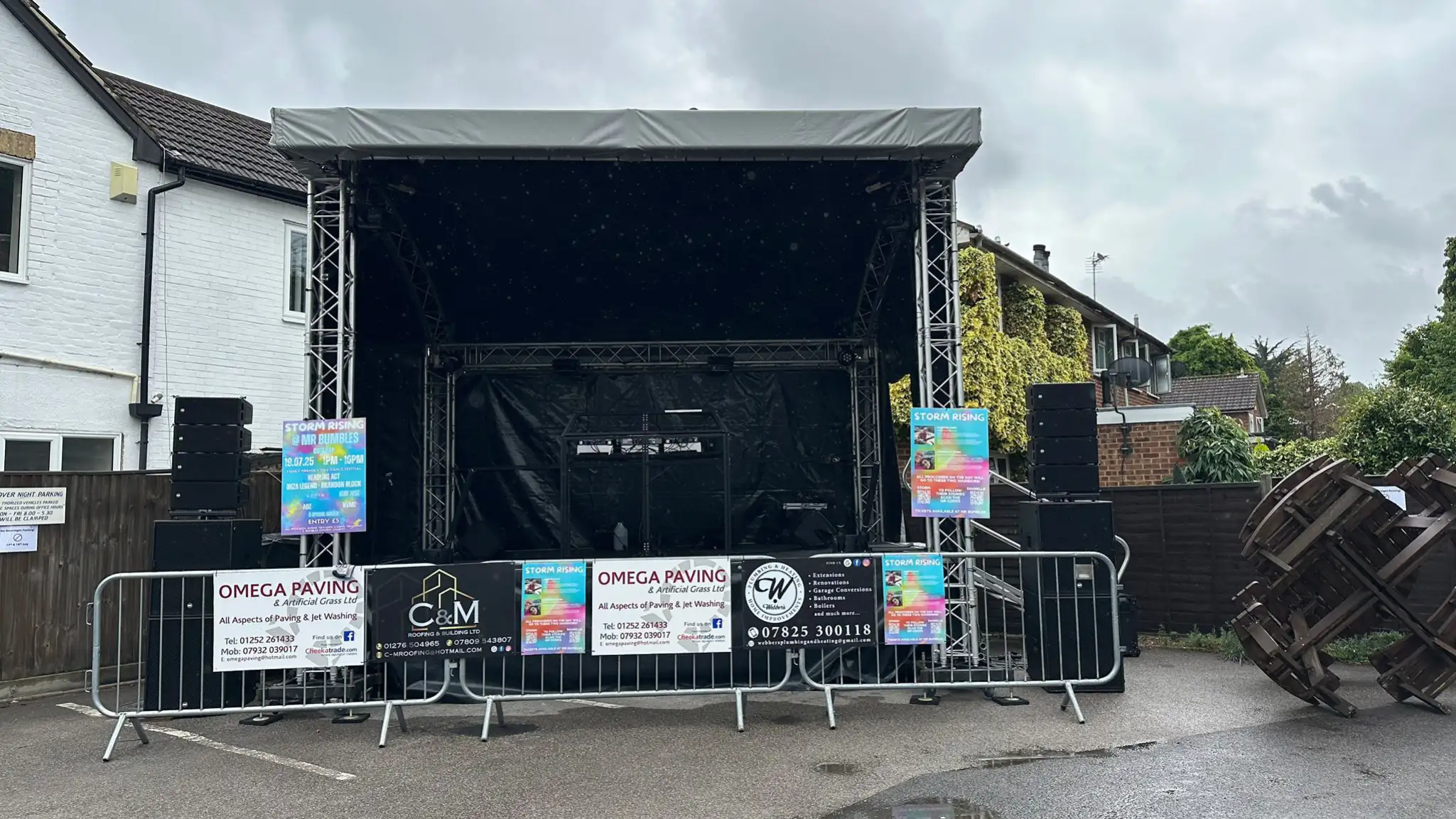
A mobile stage is a self-contained unit that arrives on a trailer and unfolds or builds into position on site.
These are often a good option for smaller to mid-size outdoor events, community events, roadshows and events where setup time is limited.
They can work well because they are designed to be deployed quickly and already include a roof structure. Depending on the setup, you may still need additional sound, lighting, steps, branding, screens or crew support.
A mobile stage can be a practical choice where access is straightforward and the event needs a professional performance area without a large-scale ground-supported build.
Ground-supported stages are more flexible and are often used for larger outdoor events, festivals and productions with more technical requirements.
They are built from modular staging and structural elements, then configured around the required roof, stage size, lighting and sound setup.
This type of stage can make sense when you need room for a band, multiple DJs, presenters, lighting, larger PA systems or more detailed branding. It may also suit events where the stage layout needs to be tailored to the site rather than chosen from a standard trailer-stage footprint.
The trade-off is that these builds generally need more planning, more space and more setup time.
For smaller outdoor events, a modular stage deck with an appropriate cover or canopy can sometimes be suitable.
This may work for garden events, food demonstrations, smaller community events or simple outdoor presentations. It can be a flexible option where the stage size needs to fit an unusual space.
However, this type of setup needs to be assessed carefully. A temporary cover is not automatically suitable for every weather condition, performer setup or technical load. The stage supplier should confirm what the structure can safely support and how it is intended to be used.
Do not choose this option simply because it is cheaper. Choose it because it is right for the event.
Stage size should be based on what needs to happen on it.
That sounds simple, but organisers often focus too much on audience numbers and not enough on performers, equipment and stage flow.
Before choosing a stage size, think about:
A DJ may only need a compact stage area. A band with drums, instruments, monitor speakers and multiple performers needs more depth. An awards presentation may need room for the host, winner, sponsor representative and photographer at the same time.
The stage also needs to look right in relation to the audience.
A small platform can disappear in a large outdoor space. A huge stage can feel out of place at a smaller community event. The right stage height and layout should help the crowd see what is happening without making the event feel distant or overbuilt.
That is why it is worth sharing your running order, performer list and site plan before the stage is confirmed.
A covered stage is designed to give useful protection from normal outdoor conditions. It is not a free pass to ignore bad weather.
Rain, wind, ground conditions and changing forecasts all need to be considered as part of the event plan.
The supplier should understand:
A professional stage setup should have clear operating guidance from the supplier. The event organiser should also have a wider plan for crowd safety, site access and communication if weather affects the schedule.
Do not make assumptions about wind limits, roof loading or whether equipment can remain in place during severe conditions. Those decisions need to be made by competent people using the specific details of the stage and site.
A covered stage is usually the centre of the production setup.
The stage affects where speakers go, where lights can be positioned, how performers hear themselves, where screens can be seen and how crew move around during the event.
For example, a live music event may need:
A corporate event may need:
A food festival may need:
The stage is not separate from those requirements. It is the platform everything else is built around.
That is why a full production approach can be easier than booking a stage, sound system, lights and crew from separate suppliers. One team can assess the whole setup, coordinate delivery and make sure the pieces work together before guests arrive.
A covered stage can only work if the site can support it.
Before booking, think about the practical side:
Outdoor sites often look easier on paper than they are in reality.
A field may be large enough for the event but difficult for vehicle access. A courtyard may be central and attractive but have restricted loading access. A venue may have a good-looking lawn but uneven ground, limited power and no practical route for a large delivery vehicle.
The earlier those issues are identified, the easier they are to solve.
The audience side of the stage matters just as much as the performance side.
For a busy event, you need to think about how people will approach, view and move away from the stage area. This may include barriers, crowd routes, protected equipment areas and clear escape routes.
The goal is not to surround every stage with unnecessary hardware. It is to prevent guests from entering unsafe areas, climbing on structures, damaging equipment or blocking access routes.
You should also think about performer access.
Where do DJs, bands, speakers and hosts enter the stage? Can they get on and off without crossing through the crowd? Is there enough room backstage for equipment cases, performers and technical crew? Are steps clear, stable and suitably positioned?
These details are what keep an event from becoming messy once people arrive.
Dry hire can work for straightforward events where an experienced organiser or production team is handling the rest.
For example, you may already have sound, lighting, technicians and a clear site plan. In that case, you may only need the stage structure and related access equipment.
Full production is often the better choice when the event includes:
With a full production setup, the same team can help plan the stage, sound, lighting, power, equipment, crew and delivery around the needs of the event.
That means fewer gaps between suppliers and fewer surprises on the day.
Beatz Hire can support both stage hire and broader event production across the South East. The right option depends on the site, the event format and how much technical support you need.
Before confirming a covered stage, ask your supplier:
A good supplier should not rush you into a generic stage package before understanding the event.
Covered stage hire should make your outdoor event easier to run.
It should give performers a proper platform, help the crowd focus on the action and give sound, lighting and technical teams a practical place to work.
Beatz Hire provides covered stage hire and full event production across the South East for festivals, food events, college events, community events, corporate events, private events and outdoor performances.
We can help with staging, sound systems, lighting, DJ equipment, screens, technical support and wider production planning.
Tell us where the event is taking place, how many people you expect, what is happening on stage and when the event is running. We will help you work out the stage setup and production support that makes sense for the event.

Planning an event locally? View Beatz Hire's stage options for London, Reading, Oxford and Southampton. Each page explains the covered and modular options available in that area.
A covered 8m x 6m arc roof is designed for outdoor events that need a defined performance area and overhead cover. Modular LiteDeck is the better fit for indoor venues, smaller platforms and custom footprints. The deciding factors are the site, audience, performers, available build space and production plan, not simply the number of guests.
Have a question or ready to get started? Let us know what you need, and our team will guide you every step of the way to make your event exceptional.
Reach out to us directly via email or phone—we’re here to assist you with any inquiries or bookings.
Stay connected and see our latest events, updates, and behind-the-scenes moments.


